30 Day Singer Fixing Common Issues With Tone TUTORIAL
Welcome to Camille’s tutorial on fixing common issues with tone! In this lesson Camille will cover some of the issues you may be encountering with your tone, and ways to deal with them. In order to deal with them, we need to get specific about exactly what we dislike in our sound.
This tutorial will be split up into three parts:
Part 1 will cover a thin, or nasal tone
Part 2 will cover a weak or breathy tone
Part 3 will focus a shouty or unstable tone
Even if you don’t struggle with every specific issue, we encourage you to watch all three sections, because you’ll learn about your vocal tract, resonance, vowel shapes, and much more.
Welcome to finding your breath! Even experienced singers need a reminder on breath control and how to engage your breath for better vocals. Here’s a little overview of what we’ll get into in this tutorial.
Lessons:
1: Introduction
2: The Singers’ Breath
3: The Warmup
4: The Warmup Part 2
5: Consistency of Breath in Singing
6: How to Apply Healthy Breathing to a Song
7: Phrasing 101
8: Bad Habits and How to Avoid Them
9: Effective Practice For Healthy Breathing
10: Recap and Conclusion
Hailed by the New York Times as ‘a robust baritone’, award-winning performer and Juilliard alum Jonathan Estabrooks continues to leave his mark on the opera, musical theatre and crossover genres. Appearing in his native Canada, the United States and abroad, his is impressive vocal performances have led to debuts at Carnegie Hall and the Kennedy Center and performances with the Toronto Symphony Orchestra, Vancouver Symphony, Seattle Symphony, Israeli Chamber Orchestra and alongside Broadway stars Ashley Brown, Aaron Lazar and Kelli O’Hara. With over half a million views on YouTube, he has been featured on the front page Billboard.com and twice in the New York Times, CBC Television, CNN and NBC.
30 Day Singer Diminished & Augmented Chords TUTORIAL
If you haven’t yet completed Camille’s tutorial on major and minor chords, we recommend you do that first! Diminished and augmented chords are more rare, especially within pop music, but they do show up from time to time. In part 1, we’ll learn to sing diminished and augmented 5ths. In part 2, we’ll focus specifically on diminished chords. And in part 3, we’ll focus on augmented chords. Let’s begin with a quick warmup!
As with all of our warm-ups tutorials, they’re designed to take you from gently warming up to stretching your skills. In part 1, we activate our breath and create space. In part 2, we build strength and focus on tone. And part 3 contains arpeggios and melismas to increase your vocal agility. This is great for all levels, but if you get to part 3 and feel it’s moving too fast, I recommend you check out the beginning warm-up tutorial and build from there.
Lessons:
1: Intro
2: Part 1: Balance Your Breath & Line Up Your Cords
30 Day Singer Daily Warmup Routine for Professional Singers TUTORIAL
This is your pro warmup routine! Because the exercises are sequential, I do recommend that you always start with an exercise or two from part 1: balancing your breath and lining up your cords. In part 2, we gradually open up to a vowel and begin sustaining pitches. Then in part 3, it’s all open vowels and agility, with a bonus speed round for singers working on runs and melismas.
Lessons:
1: Intro
2: Part 1: Balance Your Breath & Line Up Your Cords
30 Day Singer Daily Routine Practice Plan for Intermediate Advanced Singers TUTORIAL
Welcome! This tutorial is for intermediate or advanced singers, with exercises that require agility and vocal control. If you’re new to singing, or just want to brush up on the basics, try my daily routine for beginners first!
A few reminders and frequently asked questions before we begin.
Q: How often should I practice, and for how long?
A: For singers of all levels, daily practice is best. So as long as you’re feeling healthy, make it your goal to sing every day. For a regular practice session, set aside about 20-30 minutes, and feel free to gradually increase as you build stamina.
Q: When and where should I practice?
A: Practice at the time of day that your voice is feeling the best. Choose a spot that (ideally) gives you privacy to make some noise, good acoustics to hear yourself, room to stand or move around, and consider practicing by a mirror.
Last Q: What if I’m sick?
A: Give your voice and body the rest it needs to recover! If you’re dealing with a sore throat for an extended time, keep that progress going by instead doing some active listening on your down time.
About this tutorial: Part 1 is your basic warm up – five exercises that are gentle on the voice and great for warming up before more challenging stuff. Part 2 is skills growth – an additional seven exercises for you to choose from, depending on your goals and timeframe for that day. And part 3 is song work and/or ear training. Let’s get started!
Lessons:
1: Intro
2: Basic Warm-Up (Breath Activation, Balanced Resonance, Relaxed Range Work)
30 Day Singer Daily Routine Practice Plan for Beginner Singers TUTORIAL
Are you new to voice lessons? Are you looking for a daily practice routine that you can commit to? Watch my tutorial on developing a daily routine that you can adapt, depending on your goals for that day and the amount of time you have to spend. See you there!
Lessons:
1: Intro
2: Basic Warm-up (Breath Activation, Balanced Resonance, Relaxed Range Work)
Are you looking for just the basics? No fancy, complicated stuff – just good, solid technique to keep your voice in shape? Singers at any level can benefit from our tutorial on elements that should be part of your daily practice routine. Check it out!
Lessons:
1: Introduction
2: Warm-up: Breathe & Stretch
3: Part 1: Exercises that activate your breath & gently stretch your vocal folds
4: Part 2: Exercises that support growth (training wheels)
5: Part 3: Exercises that challenge you (no more training wheels) Increase your agility (note about vowel modification) & stamina (body for support)
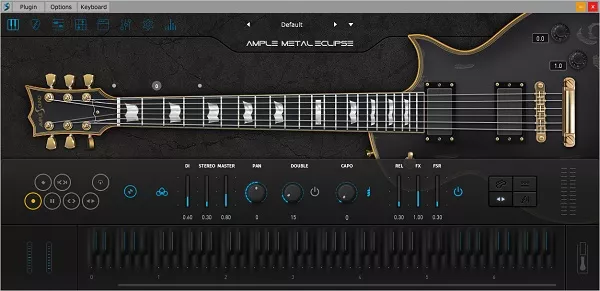
Ample Sound Ample Metal Eclipse v3.5 VST2 VST3 AU AAX STANDALONE
Ample Metal Eclipse aim to bring a ESP Eclipse I Guitar sound to your studio.
System Requirements:
Windows: Windows 7/8/10, 64-bit only (32-bit not supported).
Mac: 10.9 or higher.
VST2, VST3, AU, AAX and Standalone host.
10 GB Hard Disk, Intel i5 or higher.
Sampling:
Size:4.6 GB
Bridge pickup sample libraries.
Stereo and Mono Modes.
Sustain, Hammer On & Pull Off, Legato Slide, Slide in & out, Palm Mute, Pop, Natural Harmonic, Pinch Harmonic 10 articulations, Legato at random length & pitch & poly.
Technology:
CPC (Customized Parameters Control) – any controller can be controlled by MIDI CC or Automation.
Double Guitar.
Poly Legato and Slide Smoother.
Alternate Tuner.
Multiple Capo Logics – providing various options of automatic fingering logic to cover different performance such as solo, chorus, and so on.
Grainy – Enhance grainy of attack and produce the random humanization.
AMP Simulator:
Built-in AMP system, including 6 classic AMP models: Metal Double (modeled on Mesa Boogie Dual), Metal Treble (modeled on Mesa Boogie Triple), Lead 800 (modeled on Marshall JCM800), Jazz 120 (modeled on Roland JC120), 65 Twang (modeled on Fender 65 Twin Reverb) and 57 Delight (modeled on Fender 57 Deluxe).
Each Cabinet has 8 mic options: U87, C414, MD421, SM57, E609, C414 XLS, R121 and M160.
Room Mics.
Hundreds presets, each preset featured a riff which users can go to Riffer panel and have a preview.
Riffer:
String Roll Editor: can clearly show fingering, articulation, expression and even playing noise. Every note has 8 attributes – pitch, velocity, length, off velocity, articulation, legato, vibrato and bend, with which you can make a delicate lick.
Dice – Random Riff Generator: A click will create a new inspiration because it is not simply a random algorithm. Rather, it summarizes the rules through analyzing a bunch of music scores.
Multiple selection and operation, undo and redo etc. multiple MIDI tools, including fixed velocity, length legato and restrict, select, move, draw, erase, split, glue etc.
Strummer:
14 Strum notes + 28 ways to play for every chord.
Strum Legato – legato articulations can be played while strumming.
4 humanization settings.
Select and Detect 2 chord modes, any chords could be customized.
Strum SEQ with customized rhythm.
Delicate presets with MIDI export.
FX:
High order 8-band EQ, intuitive control of frequency response, real-time visualization of input and output spectrum, support of soloing single band..
2-Line Compressor, real-time visualization of input and output signal, two detection modes RMS & Peak, support of soft knee, auto release and auto makeup.
6-Tap Echo, real-time visualization of the processing of stereo signal, can tweak the parameters of 6 echo points individually: feedback, pan, volume etc.
IR Reverb, providing four types of IR: Room, Studio, Hall, and Larger Hall. 3D visualization of IR spectrum.
Tab Reader:
The Tab Player can load and play several prevalent guitar tablature file formats. Users can load, display and playback any specific track inside a tablature file. When used in DAWs, the Tab Player also allows users to export the tablature as an audio file.
30 Day Singer Daily Practice Routine for Sopranos TUTORIAL
Sopranos and mezzos: we’ve got your daily practice routine in this new tutorial. You can look forward to a warmup that gradually extends out from your comfortable mid-range and is catered to the higher tessitura of your voice. I’ll see you there!
Lessons:
1: Intro
2: Part 1: Warming up gently – Pairing breath to voice
30 Day Singer Daily Practice Routine for Beginners TUTORIAL
Welcome: like any skill, we grow the most when we can make our desires our habits. Regular practice makes perfect. There are no prerequisites for this course, we’re starting with the basics!
Toontrack Americana EBX v1.0.0 (SOUNDBANK) [WIN MacOS]
Although it’s had its foothold deeply rooted in the folk, gospel, blues, soul, country, jazz and rock songwriting tradition, Americana music has kept evolving and become a huge umbrella under which anything that doesn’t quite fit the commercial country music mold can thrive. This EBX was tailored to bring you a workhorse-type expansion that functions in all these scenarios – for anything from small and acoustic setups to full-on electric rock instrumentations.
The Americana EBX comes with a classic American brand bass sampled in two fundamentally different ways: one by using a traditional finger playing style and the other by muting the strings with rubber foam and striking with the thumb.
In addition to the sounds, a broad collection of presets as well as a custom MIDI library of basslines are included.
If you’re looking to boost your EZbass with a jeans-and-t-shirt-type expansion that works in any scenario, this is it. No frills or extras, just good old rock and roll, folk, gospel, blues and, well, the entire mosaic of styles that can be traced back to Americana.
FEATURE SPOTLIGHT:
A meticulously captured late-’60s electric bass guitar
Inspired by Americana music of the ’70s through to today
Ideal for anything from subtle and acoustic music to full-on rock setups
Includes finger and muted thumb options as well as a broad set of articulations for both
Offering a range from D1 to E4
Includes a wealth of presets for a wide range of tones
Comes with ‘Clean DI’ (direct input) preset options for easy external processing
Includes a custom MIDI library inspired by classic and modern Americana music
THE INSTRUMENT
An true classic.
When scouring the world of basses for an instrument that could rightfully be dubbed Americana, the Toontrack Sound Design team had their ears set on one that could muster the vast range of styles that huddle up under the genre’s umbrella.
“Seeing as this Americana encompasses anything from small and acoustic to loud, full-on electric rock band instrumentations, we needed a bass that had a leg in each world, so to speak,” comments Ulf Edlund, EZbass lead sound designer.
The instrument in question is of course a Fender Telecaster Bass.* The specific model sampled for this EBX stems from the very first batch in this new line of basses that Fender brought to market in 1968. Or maybe one should say reintroduced – the Telecaster was actually based on the very first and discarded rendition of the now-iconic Precision Bass from 1951. This makes the Telecaster Bass the first-ever Fender* reissue.
This original version of the Telecaster, with its hefty slab-style body, single-coil pickup and large chrome bridge and pickup covers, lasted until the early ‘70s. After that, changes so substantial were made to it that it essentially was a new instrument.
Welcome to add this chameleon of an instrument to your toolbox of tones – a bass that seamlessly can move between timid and loud without making any compromises and simply just adapts on its own terms, much like the Americana genre itself.
THE SOUNDS & ARTICULATIONS
Since the Americana EBX sets out to capture the broadest possible definition of the genre, it includes both an option sampled using the traditional finger style (‘Finger’) close to the bridge as well as one that was recorded using the thumb near the neck together with rubber foam mounted between the strings (‘Thumb Muted’). This gives you two completely opposite sonic approaches to the same instrument – one open and round with an abundance of sustain and one that is dry, muffled and virtually void of any decay.
“When played a certain way, this bass has an almost acoustic quality to it and, vice versa, when played in another way, it sounds big and reverberant. This is something I really think we managed to capture with these two fundamentally different techniques,” comments Ulf Edlund.
THE PRESETS
The included presets primarily hone in on round, warm and mid-centric settings, giving you a perfect palette of tones that can be traced back to anything from the rocking sound of Tom Petty and Neil Young to the more bare bones-type approach heard in songs by the likes of Emmylou Harris and Gillian Welch. To further give you the option of easy external processing, clean direct input (DI) presets for both the ‘Finger’ and ‘Thumb Muted’ options are of course included.
THE MIDI
The included MIDI library presents a repertoire of basic basslines inspired by Americana music of then and now. Expect a fundamental collection that you can use the onboard MIDI features in EZbass to customize, slice and dice to fit your already written songs or use as a creative springboard for your yet-to-be-written pieces.
SYSTEM REQUIREMENTS:
1.2 GB free disk space, 4 GB RAM (8 GB or more recommended)
Toontrack Heavy Metal EBX v1.0.0 (SOUNDBANK) [WIN MacOS]
Any heavy metal arsenal needs a proper power tool for when things are about to get rough – that lead-heavy, wrecking ball-like piece you wheel in when your mix calls for a tone that’s straight-out-of-the-furnace molten hot. This is it.
The Heavy Metal EBX comes with a modern-day bass, handpicked for its ability to muster tones to span the entire gamut of heavy metal – from its formative 1970s, through the new wave of British heavy metal and up until today. In addition to the sounds, the Heavy Metal EBX also includes a custom MIDI library as well as a collection of presets offering tones tailored for anything from classically muffled, warm and round to modernly bright, edgy and distorted.
If you’re looking for an instrument that offers extreme heavy metal firepower, you’ve got it.
FEATURE SPOTLIGHT:
A meticulously captured modern-day high-end bass
Inspired by anything from Judas Priest and Iron Maiden to Pantera and Five Finger Death Punch
Sampled with finger and pick options as well as a broad set of articulations for both
Offering a range from A0 to E4
Includes a wealth of presets for a wide range of heavy metal-inspired tones – from muffled, warm and round to bright, edgy and distorted
Comes with a ‘Clean DI’ (direct input) preset option for easy external processing
Includes a custom MIDI library inspired by classic and modern heavy metal
THE INSTRUMENT
50 years of heavy metal, distilled into one bass guitar to rule them all.
When the Toontrack sound design team had their eyes set on a bass with its roots in traditional heavy metal but that still offered the detail, the clarity and the articulate expression of a modern instrument, whittling down the choices to one winning ticket ended up being fairly simple: Ian Hill’s (Judas Priest) limited edition, signature Spector Euro4.* This bass was designed to celebrate the band’s five decades at the pantheon of metal and has all the traits of a classic ‘80s-era Spector – the solid maple body wings, the three-piece maple neck and the rosewood fingerboard – but also offers tons of features that takes it into the new millennium and beyond. One of the standout details of the lot is the onboard TonePump, an active preamp with an internal boost trim pot. The specifics of the circuitry in this preamp offers lots of tube-like characteristics, enabling you to really crank the output of the bass without the tone cracking up – it just gets warmer, beefier and, frankly, more heavy metal.
THE SOUNDS & ARTICULATIONS
The Heavy Metal EBX was sampled with both finger and pick articulations, allowing you to get a traditional and rounder stroke at the same time as you’ll have the option of a more metallic and edgy approach. As for range – with a reach all the way down from A0 up to E4, you’ll be able to create nuanced performances for any imaginable riff that comes to mind.
THE PRESETS
While this EBX is rooted in the tones of the formative first couple of decades of heavy metal, it also offers an outlook on the genre’s reach into today. So, regardless of whether you are looking for a classic new wave of British heavy metal tone or something more apt for this side of the millennium, the included library of presets has the tones you need to complement even most dense wall of guitars or cut through in any layered production. Add to that the ability to use the ‘DI’ (direct input) and ‘Multi-Out’ options to process your tones externally and you’ll have endless options to shape stadium-size heavy metal bass tones.
THE MIDI
The included MIDI library covers riff-heavy material where there is no mistaking that the bass has a prominent role. Expect anything from old-school, late 1970s vibes and big 1980s-style riffs to more modern-sounding heavy metal of the past two decades. This collection of MIDI in conjunction with the onboard MIDI features in EZbass will have you producing ground-shattering material in no-time.
SYSTEM REQUIREMENTS
1 GB free disk space, 4 GB RAM (8 GB or more recommended)
Learn piano from motor, cognitive and auditive skills and build your learning autonomy
Learn the piano and keyboard from cumulative skills that contribute for your independence. The key goal is generously providing you smart effective tools for your active learning. With such tools you will be capable to acquire more information and learn to perform the songs you wish saving your time.
The skills featured are: melody, accompaniment, accompanied melody, music reading, piano technique and musical perception and creation. These abilities make learning faster and help learning the songs you wish. You will learn to play piano and music elements, not only to reproduce tunes.
An in depth look at the art of strumming and playing the guitar, a must for all beginners.
Welcome to my course simply entitled how to master the art of strumming the guitar.
Learning to strum the guitar can be extremely challenging for the beginner.
Using my proven techniques that I have developed over the years as a professional guitar teacher, I am going to take you from a beginner to a confident player of the guitar.
Using these methods, I have helped countless students achieve their goal of playing the guitar.
The course has over 30 lessons that are easy to follow and they progress in logical steps that are simple to understand.
In the early stages of the course, special attention is made to the basic technique required to strum the guitar. Unfortunately, many aspiring guitarists are so eager to play the instrument that they develop bad techniques that can spoil both the sound and their enjoyment of playing the guitar. So please do pay particular attention to the opening chapters on the course.
I have designed the course in such a way that strumming is the focus and not chords. In fact the whole course can be worked through with only using 2 easy to play chords.
We will look at initial techniques, correct position of the guitar, holding the pick, counting, and working with a metronome.
Each lesson contains on screen tablature and no music theory is required.
The lessons will feel more like a workshop as you play through each lesson and do be prepared to play the guitar with me in some of the lessons.
Please work through the first 4 lessons and pay special attention the methods I describe to correctly hold the guitar, and pick and the method of moving the arm and wrist through the strumming motion.
Always try and work with a metronome to ensure the correct tempo and timing.
If you would like me to critic your playing and give any advise then do not hesitate to send me a link or upload a short video of you playing.
I have attached a PDF that gives you all the patterns used in the course plus a whole bunch more for you to have a go at.
Have fun and the main thing is to enjoy yourself!
Geoff Sinker
What you’ll learn
Learn the correct way to hold the guitar
Learn How to hold the pick correctly
Learn how to count in a musical context
Learn how to work with a metronome
Learn how to correctly strum the guitar
Combine strumming patterns using 1/4, 1/8 and 1/16 beats

![Toontrack Americana EBX v1.0.0 [WIN MacOS]](https://vstorrent.info/wp-content/uploads/2022/05/Toontrack-Americana-EBX-v1_0_0-WIN-MacOS-1.webp)
![Toontrack Heavy Metal EBX v1.0.0 [WIN MacOS]](https://vstorrent.info/wp-content/uploads/2022/05/Toontrack-Heavy-Metal-EBX-v1_0_0-WIN-MacOS-1.webp)